
WordPress vs custom website
WordPress vs a custom website: an honest comparison of cost, speed, security, editing and ownership, with clear situations where each one is the better choice.

WordPress vs a custom website is one of the first decisions when you plan a new site, and both are reasonable choices. WordPress is a free, open-source system that powers a large share of the web, with thousands of themes and plugins. A custom website is built for your business from scratch, either hand-coded or on a content management system made for that project. The right choice depends on who will maintain the site, what it has to do and how much you want to depend on third-party add-ons.
I build custom sites, so I am not neutral. I'll try to be fair anyway, including saying when WordPress is the better option.
The short answer
- Choose WordPress if you publish a lot of content, have someone who knows WordPress on your team or on call, and need a common feature that a reputable plugin already does well.
- Choose a custom website if speed, security and a simple edit panel matter more to you than a huge plugin library, if you do not want to manage updates, or if your site needs logic that plugins handle awkwardly (calculators, multi-location content, integrations with your CRM).
Side-by-side comparison
| Factor | WordPress | Custom website |
|---|---|---|
| Upfront cost | Can be low with a ready theme | Usually higher than a theme-based build |
| Running cost | Hosting, premium plugin and theme licences, maintenance | Hosting; no platform or plugin licences |
| Speed | Depends heavily on theme and plugins | Lean by default, only what the page needs |
| Security | Popular target; requires regular updates | Smaller attack surface; fewer moving parts |
| Editing | Familiar editor, but can be overwhelming | Panel built around your content, simpler |
| Flexibility | Huge plugin ecosystem | Anything can be built, but each feature is built |
| Developer availability | Many WordPress developers | Depends on the original developer or code quality |
| Ownership | You own the site if hosted in your name | You own the code and content if stated in the agreement |
Neither column wins everywhere. The question is which trade-offs hurt your business less.
Where WordPress shines
WordPress earned its popularity honestly. It is strong when:
- You publish often. Blogs, news, recipes, resources. The editor is built for this.
- You need a standard feature. Event listings, memberships or a simple store can often be added with a mature plugin.
- You want a large pool of developers. If your developer leaves, finding another WordPress person is relatively easy.
- Your budget is tight and the site is simple. A well-chosen lightweight theme can get you online quickly.
The catch is that a WordPress site is only as good as the theme and plugins on it, and the person maintaining them.
Where WordPress causes trouble
The problems I see on small business WordPress sites are rarely WordPress itself. They are what gets piled on top:
- Heavy multipurpose themes that load code for features nobody uses.
- Plugin sprawl. A slider plugin, a form plugin, a popup plugin, two SEO plugins, a security plugin, a cache plugin. Each one adds weight and a potential conflict.
- Missed updates. Outdated plugins are a common way sites get hacked.
- An editor that scares owners. Page builders inside WordPress can make a simple price change feel risky.
If your site already has these issues, my article on why your website is slow explains which ones you can fix and which are built in.
Where a custom website shines
A custom site makes sense when:
- Speed is important, for example when you run ads and every second of loading costs money.
- You want an edit panel that matches your business. A clinic edits doctors and hours; a contractor edits projects and service areas; a realtor edits listings and calculators. Nothing else to learn.
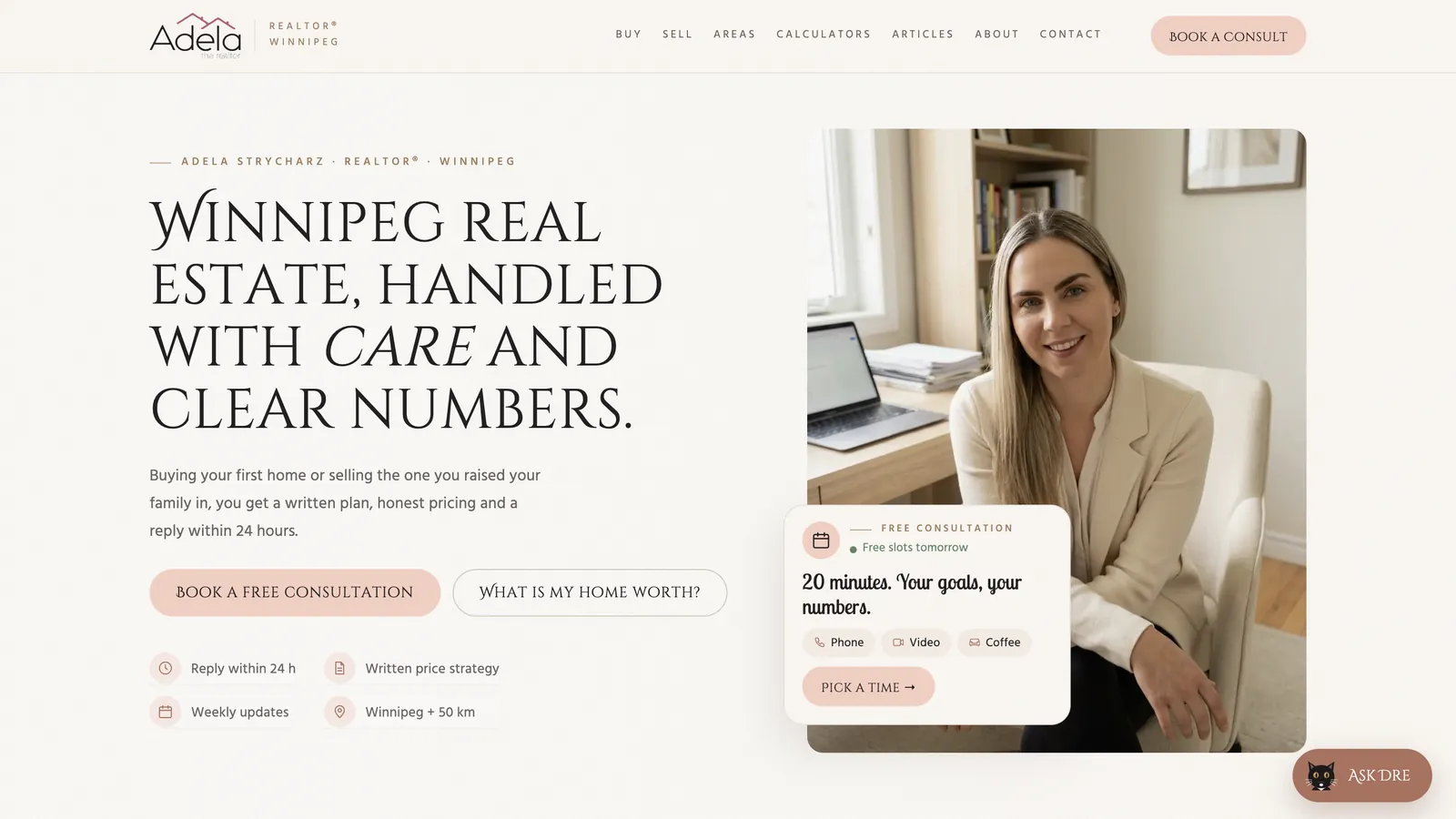
- You need custom logic. Quote calculators, booking rules, multi-location pages, sending enquiries straight to a CRM. For example, the site for Adela Strycharz, REALTOR® in Winnipeg has seven calculators built into it.
- You do not want to manage updates. Fewer components means less to patch.
- You want no platform lock-in. The code is yours and can be moved to any hosting.
Where a custom website is the wrong choice
Be honest about these:
- Very low budgets. If you have a few hundred dollars, a custom build is not realistic. Start with a builder and upgrade later.
- Heavy publishing teams that already know WordPress well and need its editorial workflow.
- Dependence on one developer. If the code is messy and undocumented, you are tied to the person who wrote it. Ask how the code is organized and whether another developer could take it over.
What I build and why
I build sites either hand-coded or on a custom CMS made for each project. There is no page-builder subscription, you own the code and content, pages are light, SEO is fully under control, and forms and CRM integrations work without plugins. You can read more on hand-coded websites and on the custom CMS page.
Prices start at $3,000 for a business website and $11,900 for a large site on a custom CMS, in Canadian dollars. If WordPress fits you better after a short call, I'll say so; I'd rather lose a project than build the wrong thing.
The cost over three years, not just at launch
Compare the total, not the first invoice. For WordPress, add hosting, premium theme and plugin renewals, and someone's time for updates and fixes over three years. For a custom site, add hosting and any changes you will not make yourself. Sometimes WordPress is cheaper over that period, sometimes not. Doing the sum is the only way to know for your case.
How to decide in five minutes
Answer these questions:
- Who will update the site, and how often?
- Do you need features beyond pages and forms?
- Will you run paid ads to the site?
- Do you have a WordPress developer you trust for ongoing updates?
- How much does a slow or hacked site cost you in a month?
If your answers lean towards frequent publishing and an available WordPress team, go WordPress. If they lean towards speed, simplicity and custom features, go custom. If you are torn, a free 30-minute consultation usually settles it.
See what is holding
your website back
Paste the address: I’ll check speed, the mobile version, tappable contact details and analytics. Results right away, for free.

12+ years in online marketing, 100+ clients. I build websites, Google Ads and Meta ads campaigns, CRMs and automations for small and mid-sized businesses. About me →
WordPress or
custom code
Is WordPress free?
The software is free and open source, but running a WordPress site is not. You pay for hosting, often for a premium theme and plugins, and for someone's time to keep everything updated and secure. Those running costs are worth adding up before you compare WordPress with a custom build.
Is a custom website harder to edit than WordPress?
Usually it is easier, because the edit panel only contains what your business needs: services, prices, team, projects. There are no unused menus or page-builder controls. The key is that the developer builds and explains the panel properly, so you can make everyday changes without help.
Can I move from WordPress to a custom website without losing rankings?
Yes, if it is done carefully. Keep the content that ranks, map old addresses to new ones with redirects, and keep an eye on Search Console after launch. I keep your domain and move your content as part of every rebuild, so you do not start from zero with Google.
Which is more secure, WordPress or custom?
Both can be secure or insecure. WordPress is a popular target because it is so widespread, and outdated plugins are a frequent entry point, so it needs regular updates. A lean custom site has fewer components to attack, but it still needs good code, secure hosting and backups.
Unsure which way
to build your site?
Tell me what the site has to do and who will update it. I'll tell you which option fits, even if it is not the one I build.