
Marketing agency or freelancer?
Marketing agency vs freelancer: what each really costs a small business, where each fails, and five questions that make the choice obvious.

For most small businesses spending under $5,000 a month on marketing, a capable freelancer or one-person agency is the better choice than a full-service agency: you pay for the work rather than the overhead, and you talk to the person who actually runs your campaigns. A marketing agency starts to make sense when you need several specialists at once, every week, and you have the budget to keep them busy.
That is the short version of marketing agency vs freelancer. The longer version depends on how much you spend, how many channels you need and how much management you want to do yourself. Here is how I would think it through if I were in your seat, with the caveat that I am a one-person agency myself, so read my bias accordingly.
What you actually pay for in each model
An agency fee covers more than the person running your ads. It pays for account managers, sales staff, an office, software licences and profit on all of it. That is not a scam; it is how agencies are built. But it means a smaller share of your fee goes to hands-on work.
A freelancer's fee mostly covers their own time. The risk shifts: there is no bench of colleagues if they get sick or overloaded, and their skills are usually narrower.
| Question | Typical agency | Typical freelancer |
|---|---|---|
| Who does the work | Often a junior specialist, managed by an account lead | The person you hired |
| Who you talk to | Account manager | The specialist directly |
| Range of skills | Wide: design, ads, SEO, video under one roof | Usually one or two areas |
| Monthly cost for one channel | Often higher, minimums are common | Usually lower |
| Contract | Often 6 to 12 months minimum | Usually flexible |
| Risk if one person leaves | Low, someone replaces them | High, unless they work with partners |
Five questions that settle the choice
1. How many channels do you really need right now? If the honest answer is one or two, such as Google Ads and a website, a specialist covers it. If you need ads, SEO, social posting, video and PR running together every week, an agency's breadth starts to pay off.
2. Who will make decisions on your side? Agencies are built to work with marketing managers. If you are the owner and have 20 minutes a week, you want someone who can take a short brief and run with it, not someone who sends a 40-slide deck for approval.
3. What happens to your accounts if you part ways? Ask this before signing. Your Google Ads account, Meta Business account, domain and website code should be registered in your name. With me they always are, and that point matters far more than agency versus freelancer.
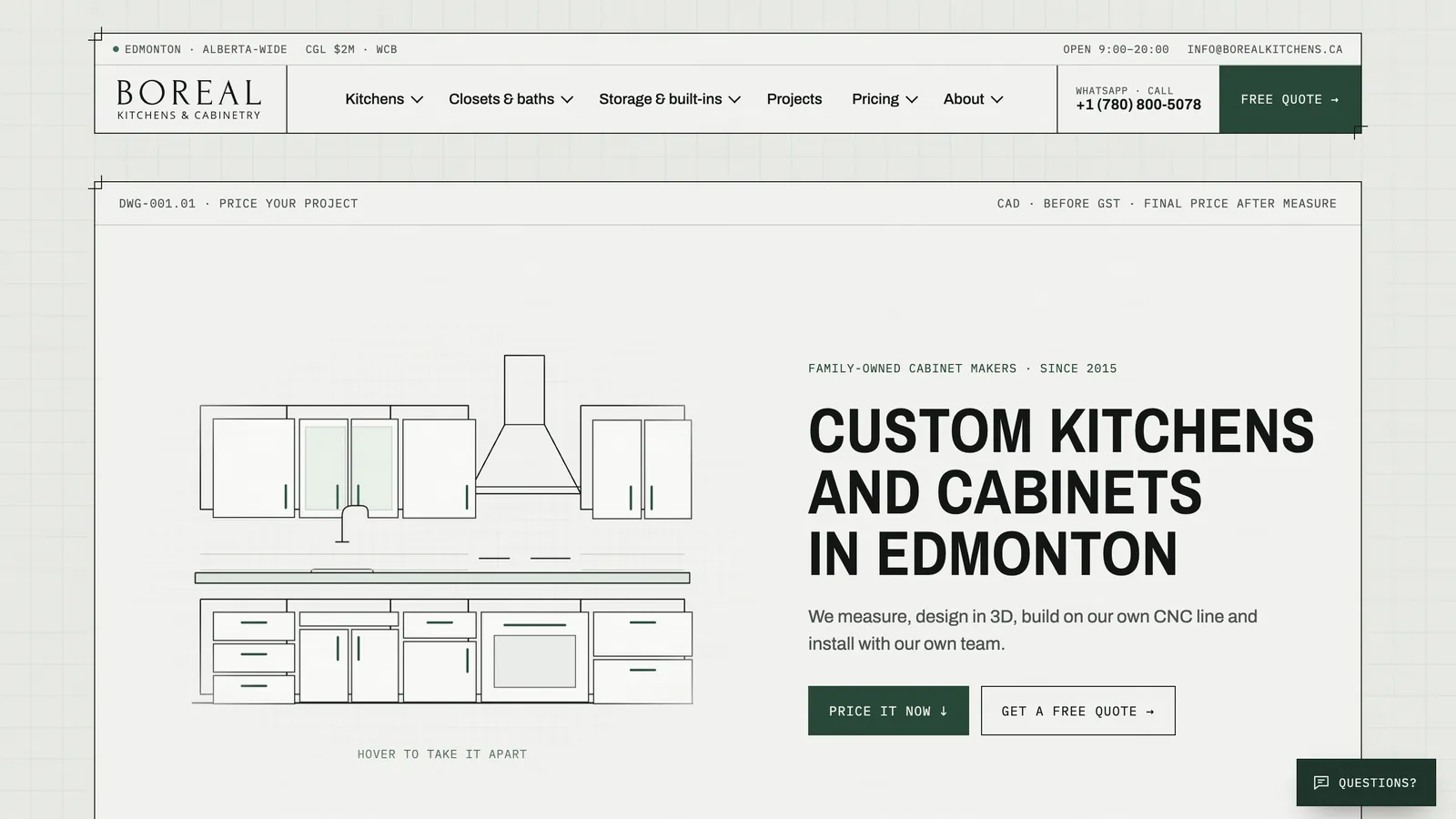
4. Can they show real work in a similar business? Ask for case studies with numbers, ideally in your industry or a close one. My own are on the case studies page, including Boreal Kitchens in Edmonton, where I built the website, ads, CRM and SEO.
5. What is the notice period? A twelve-month lock-in before anything has been proven is a warning sign with either model. My management contracts have no minimum term and end with one month's notice.
When an agency is the right call
Some situations really do need an agency:
- You run national campaigns with TV, print and digital at once.
- You need a steady stream of video, photography and design every week.
- Your marketing team wants a partner with many specialists to plug in on demand.
- Your internal approval process needs dedicated account management.
If that is you, choose an agency that names the people working on your account and puts them on calls with you.
When a freelancer is the right call
A freelancer or a one-person agency usually fits better when:
- You are a local or regional business with one or two main channels.
- You want to talk to the person who touches your campaigns.
- Your budget is modest and you want most of it going to work, not coordination.
- You prefer flexible terms and want to test before committing.
The weak spot is coverage. A single freelancer cannot be a designer, a copywriter, a video editor and an ads specialist at once, and anyone who claims they are is stretching.
The third option: one person who leads, with partners
There is a middle path, and it is how I work. I do the core work myself: strategy, websites, Google Ads, Meta ads, SEO, analytics and CRM. For things outside that core, such as TikTok or LinkedIn ads, branding or social media management, I bring in a trusted partner. The contract, deadlines and communication stay with me, so you still have one person accountable.
This keeps the direct contact and the lower cost of a freelancer while covering the gaps that usually make owners nervous. It is also why I prefer to call it outsourced marketing rather than freelancing: you hand over a function, not a task list.
Questions to ask on the first call
Whoever you talk to, a short list of questions reveals a lot in the first 30 minutes:
- Who exactly will work on my account, and can I talk to them directly?
- What will you need from me each week, and how fast do you expect answers?
- How do you measure success, and what will the monthly report show?
- What happens in month two if the first campaign does not bring enquiries?
Listen for concrete answers. Vague replies about "visibility" or "brand presence" usually mean nobody has thought about your numbers yet.
How to compare quotes fairly
Put every proposal on the same page before you compare prices:
- Separate the management fee from the ad budget.
- List what is included each month: number of campaigns, reports, calls, revisions.
- Check who owns the accounts and the website code.
- Note the minimum term and the notice period.
- Ask how fast they reply. I answer within one business day.
If you want a deeper look at what a part-time marketing lead costs, my piece on fractional marketer costs breaks it down. And if you are still deciding whether you need outside help at all, signs it is time to hire a marketer may help you decide.
Let’s talk
about your business
Before the call I review your website and ads. After the call you get an action plan and a price range in writing.

12+ years in online marketing, 100+ clients. I build websites, Google Ads and Meta ads campaigns, CRMs and automations for small and mid-sized businesses. About me →
Agency or freelancer:
follow-up questions
What does a marketing freelancer usually cost in Canada?
Rates vary widely by experience and city, so treat any figure as rough. Many freelancers charge by the hour for small jobs and a monthly fee for ongoing work like ads or SEO. For reference, my consulting time is $70 an hour, Google Ads management starts at $750 a month and Meta ads at $700. Always compare scope, not just the number.
What if my freelancer disappears halfway through a project?
That is the real risk, so protect yourself upfront. Keep every account, domain and file in your own name, insist on a written agreement with deadlines, and pay in stages rather than everything at once. I work on a 30/40/30 payment split with dates in the contract, so neither side carries all the risk.
Do agencies get better ad results because they spend more with Google?
Not in any way you would notice as a small advertiser. Google and Meta auctions do not reward the size of the agency running the account. Results come from the structure of the campaigns, the offer, the landing page and how carefully someone watches the numbers. A focused specialist can do that as well as a large team.
Which model fits
your business?
Tell me about your goals and budget. In a free 30-minute call I'll tell you which setup makes sense, even if the answer is "not me".