


Website for contractors
A website for contractors has one job: turn a homeowner's search into a quote request. The pages, proof and details that make renovators, roofers and trades get called.

A website for contractors has one job: turn a homeowner or property manager who is searching right now into a quote request. Beautiful design helps only if it supports that. The sites that win jobs for renovators, roofers, electricians, plumbers, landscapers and cabinet makers share the same features: clear service pages, real project photos, honest price guidance, visible licences and insurance, and a quote form that works on a phone with one thumb.
Below is what I would put on a contractor site, why each part matters, and the mistakes I see most often on trades websites across Canada.
How homeowners choose a contractor online
The typical path looks like this. Someone notices a problem or plans a project. They search on Google, often on a phone, often with the city name: "basement finishing Calgary", "roof repair Halifax", "electrician near me". They look at the map results and the top few sites. They open two or three, look at photos and reviews, and check whether you serve their area. Then they call or send a form, sometimes to all three.
Your site needs to win at each step: appear in the search, look credible in the first seconds, prove you do this kind of work well, and make contact easy. Miss one and the job goes to someone else.
The pages a contractor site needs
- A page for each main service. Kitchen renovations, bathroom renovations and basement finishing are different searches and different customers. One page called "Services" listing all of them ranks for none.
- Service area information. The cities and neighbourhoods you cover. If you serve a metro area plus nearby towns, say which. Separate pages for main areas can help, as long as each has genuinely useful local content and is not a copy with the city name swapped.
- Projects or portfolio. Before and after photos with a short story: what the client wanted, what you did, how long it took, roughly what it cost.
- About. Who you are, how long you have been in the trade, who will actually be on site.
- Process. From the first call to the final walkthrough. Homeowners fear mess, delays and surprise costs; a clear process calms all three.
- Contact and quote request. Phone, form, service area, hours.
Proof that makes homeowners trust you
Contractors are hired on trust. Show it plainly:
| Proof | How to show it |
|---|---|
| Licences and permits | State the licence types you hold, where your trade or province requires them |
| Insurance and workers' compensation | Mention liability insurance and coverage such as WSIB in Ontario or WCB in many other provinces, where it applies to you |
| Warranty | Spell out what is covered and for how long |
| Reviews | Link to or show real Google reviews; never invent or edit them |
| Real photos | Your crew, your vehicles, your finished jobs |
| Associations | Local home builders' associations or trade bodies, only if you are a member |
Price guidance without giving away your quote
Most contractors resist putting prices online because every job is different. That is fair, but showing nothing makes people assume the worst. Middle ground that works:
- A typical range for your most common jobs, using your real numbers, with a note on what pushes it up or down.
- What drives the price: size, materials, structural changes, permits.
- Two or three example projects with their final cost range.
- A free or paid estimate policy stated clearly.
Real ranges filter out tyre-kickers and attract people who are ready to spend.
A quote form that gets used
The form is where contractor sites lose the most leads. Keep it short and useful:
- Name, phone, postal code or city, type of project, and an optional message.
- An option to upload photos of the space or problem. It saves you a site visit for small jobs.
- A line telling them when you will call back.
- A tap-to-call button and, if you use it, a WhatsApp or text option.
Then make sure every enquiry reaches you fast, ideally on your phone and in a simple CRM, so it does not get lost while you are on a roof.
Getting found: SEO, Maps and ads
A contractor site works best together with local visibility:
- Google Business Profile with your service area, categories, photos and reviews. For many trades, the map results bring more calls than the website itself.
- Local SEO on service and area pages, as I describe in local SEO and Google Business Profile.
- Google Ads and Local Services Ads, which run in many Canadian cities for many trades. Ads bring calls quickly while SEO builds up. More on local Google Ads and Local Services Ads.
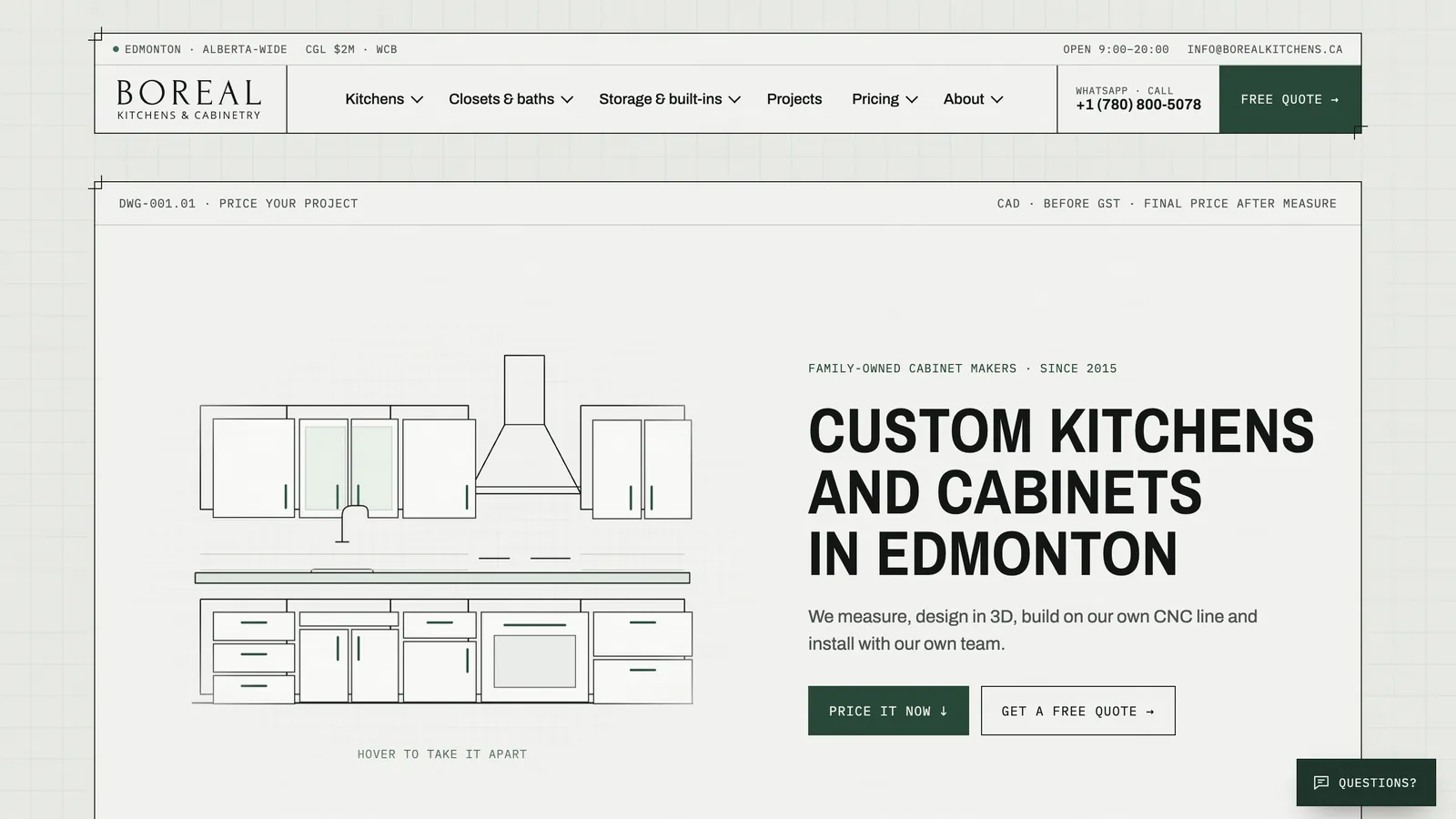
An example: for Boreal Kitchens & Cabinetry in Edmonton I built the website and run ads, chatbots, CRM and SEO. The site now has 200 keywords on the first page of Google in Canada.
Mistakes I see on contractor websites
- Stock photos of hard hats and handshakes. Customers can tell. Your own phone photos of real jobs are better.
- No phone number in the header on mobile.
- One "Services" page for everything.
- A portfolio with no words. Photos without context do not explain why they should hire you.
- Outdated content. A "Spring special" in November, or a licence number that changed.
- Seasonal blind spots. Not adjusting the site and ads for your busy and slow seasons, which in Canada can be dramatic for exterior work.
What it costs and how long it takes
A focused landing page for one service starts at $1,300 and can be live from 10 days, ideal before the season starts. A full business website with service and area pages starts at $3,000, and the Growth package with Google Ads setup and analytics starts at $4,300, all in Canadian dollars. You can see how I approach the whole trade on marketing for construction companies and marketing for plumbers, electricians and HVAC.
If you want more quote requests before the next busy season, send me a short brief and the jobs you want more of.
Let’s talk
about your business
Before the call I review your website and ads. After the call you get an action plan and a price range in writing.

12+ years in online marketing, 100+ clients. I build websites, Google Ads and Meta ads campaigns, CRMs and automations for small and mid-sized businesses. About me →
Contractor
website questions
Should a contractor website show prices?
Usually yes, as ranges or "from" prices, plus an explanation of what moves the price. It reassures homeowners and filters out people who are not ready to spend. If every job is custom, show two or three example projects with their final cost range. Use only real numbers from your own work.
How many pages does a contractor website need?
Typically a homepage, one page per main service, a projects page, an about page, a process or FAQ page and a contact page. Contractors covering several distinct areas may add area pages, but only with genuinely local content. Quality and clarity matter more than the number of pages.
Do contractors need a website if they have a Google Business Profile?
The profile brings calls, but many homeowners still click through to the website before deciding, especially for larger jobs. A site lets you show detailed projects, prices, process and licences, and it is the place ads and the profile can link to. The two work best together.
When should a contractor launch a new website?
A few weeks before the busy season starts, so Google has time to pick up the pages and ads can gather data. For exterior trades in Canada that often means late winter. Starting during peak season is hard, because there is little time for photos, copy and approvals.
Get a site that
brings quote requests
Tell me your trade, your service area and the jobs you want more of. I'll suggest a structure and a price within one business day.